

_jfif.jpg)

Natural and Cultural Heritage of Southern Local School District
The following content was developed by Lance Stephens’ 2026 Nature Writing and Interpretation class at Southern Local School District’s Miller High School in Hemlock, Ohio. This elective course includes students ranging from freshmen to seniors.
Over the course of the year, Rural Action’s Environmental Education team visited the class 20 times to research and explore the natural and cultural heritage of their community, with a special focus on local labor history and the national significance of Robinson’s Cave.
To learn more about this project, continue reading.
This project was funded by the National Forest Foundation. We would also like to extend our sincere thanks to Mr. Stephens and Miller High School for partnering with us and making this project possible.

After spending the winter researching Robinson’s Cave, the students had the opportunity to participate in a field trip to the cave to further explore the site and share their findings with Thomas Stevenson, a professor in the Restaurant, Hotel, and Tourism Program at Ohio University, along with five of his students.
The field trip included students reading and discussing the interpretive panels while exploring the cave, followed by a formal presentation by the Miller High School students. The day also featured a more informal discussion between the Ohio University students and the Miller students about tourism as an industry and its relevance to Southeast Ohio.
The next eight videos feature Miller High School students presenting their research and sharing their findings in front of Robinson’s Cave.
In this video, Marlee McLaughlin introduces Robinson’s Cave to the audience and reflects on visiting the cave as a child with her family. Marlee explains that returning to the site with a deeper understanding of its historical context gave the experience new meaning and made the cave feel very different from how she remembered it growing up.


Marlee explains that Robinson’s Cave served as an early meeting place for coal miners who would later help form the United Mine Workers of America. She shares how workers gathered secretly within the cave, taking advantage of its remote location and remarkable acoustics. Marlee also notes that the cave’s natural acoustics are responsible for the echo heard as she speaks in the video.
Here Marlee mentions Christopher Evans, who as a New Straitsville resident and a well-known union organizer who used Robinson’s Cave to lead miners throughout the long Hocking Valley Coal Strike of 1884-1885.


Marlee shares two Google reviews that do not accurately reflect the historical significance of the cave or the surrounding community. She goes on to explain that all history is important, no matter how large or small, because every story is interconnected. Marlee also notes that the site is featured on Ohio’s Winding Road before introducing Elyza Plumley.
Elyza shares that in the 1870's miner met in this cave and that a strike happend in 1884 through 1885.


In 1890 the United Mine Workers of America becomes offical.
This cave later became known for housing a wooden merry-go-round in the early 1900's, decades after it had served as a secret gathering place for striking coal miners during the 1880s.
Elyza explains that coal mining was still active in the New Straitsville area during the 1970s, though the industry was steadily declining due to dangerous working conditions and diminishing coal reserves. She notes that in the early 2000 alsmost all the mines in Ohio had closed.


Elyza closes by reflecting on the miners’ long fight for safer working conditions and better treatment within the coal industry.

The presentations shared in these videos highlight not only the historical significance of Robinson's Cave, but also the value of place-based learning and community storytelling. Through their research, fieldwork, and discussions with Ohio University students and faculty, the Miller High School students gained a deeper understanding of the region’s coal mining history and the ways heritage tourism can help preserve and share these important stories. By exploring the cave firsthand and presenting their findings on-site, the students helped bring the history of New Straitsville to life for future audiences.
Elliot Klingler, pictured on the far right in this image, also participated in the presentation at Robinson’s Cave. Unfortunately, the audio captured during his presentation was unclear and does not allow his remarks to be heard. As an alternative, his written words are below:
Robinsons cave started as a safe place for coal miners to meet in secret in 1870. These meetings gave the miners a voice. New Straitsville resident Christopher Evans, a well known union organizer used the cave to lead miners through out the long Hocking Valley Coal Strike of 1884–1885. In 1886 the Knights of Labor founded the National District Assembly #135.
Coal Strike Beginning in June 1884 tensions between the Columbus and Hocking Coal and Iron company and striking miners led to violence and destruction.
The notes refer to a significant era in American labor history. Robinson's Cave, located in New Straitsville, Ohio, served as a secret meeting place for miners who were blacklisted or threatened for trying to unionize. These secret meetings eventually led to the formation of the United Mine Workers of America (UMWA).
The strike mentioned (1884–1885) is also famous because it resulted in the New Straitsville mine fires—striking miners pushed burning railcars into the mines, and some of those fires are actually still burning underground today!
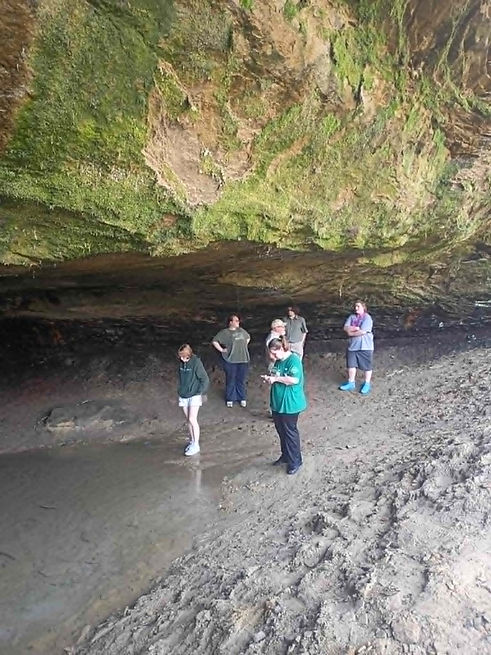

While some students focused their research on the history and cultural significance of Robinson's Cave, others conducted field studies centered on the ecology they observed while exploring the school’s land lab. The following information highlights their findings and observations about the natural environment and ecosystems they encountered during their research.
Olivia Cruze and Carlee Santek were inspired by the butterflies they observed while hiking and exploring. They created a step by step process of how to pin a butterfly.
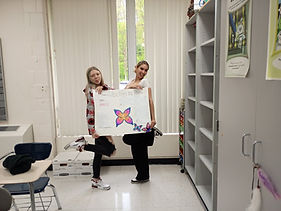
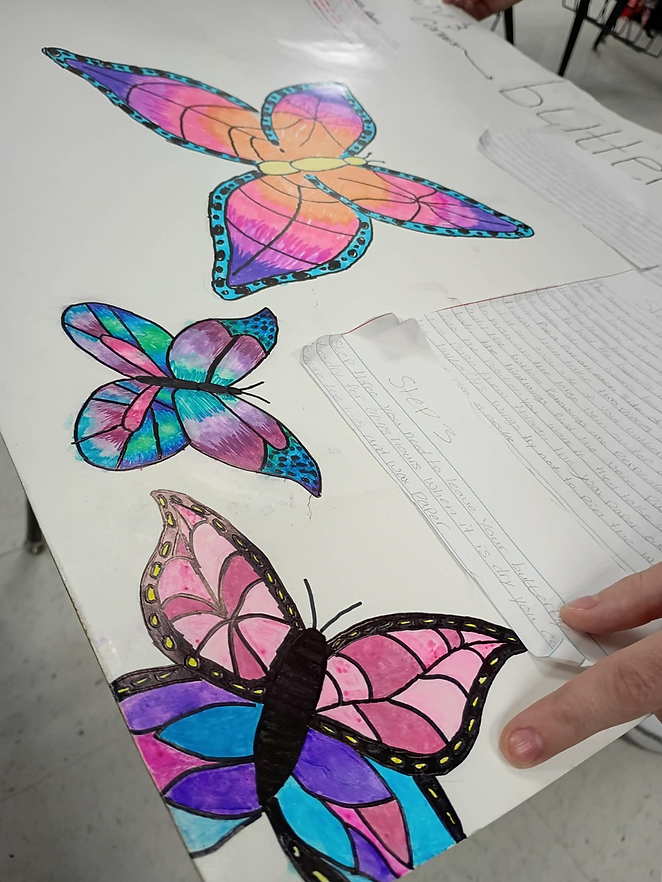
1. The first step to framing a butterfly is to relax your butterfly because when a butterfly dies it stiffens up. So to soften the wings you can line your container with a wet towel then place the butterfly in an envelope and fold it in half the cut off corner so that the butterfly is not getting too wet but still enough moisture for relaxation.Before moving on to step 2 make sure you can open and close your butterfly's wings if you may have to wait another day or so.
2.The second step to framing your butterfly is too position and pin Cover your styrofoam board with a sheet of wax paper and pin down your corners down then squeeze your butterfly's thorax to separate it's wings and then put a pin halfway through the thorax then push the rest of the pin in your board to pin it in place. it is important to be gentle with your butterfly because their scales rub off easily. Put a pin on each side of the abdomen and thorax then take two pieces of wax paper and sit it on each side of your butterfly. Use a pin to push up the large vein on top of the forewings until the bottom forewings are perpendicular to the body. the hindwings find the vein push it up into the position you want it then take a couple pins push them through the wax paper outlining the butterfly's wings try not to pin the wings but get as close as possible.
3. Step three you need to leave your butterfly to dry for 24-48 hours when it is dry you can remove the pins and wax paper
Fun Facts:
-
Butterflies uses sensors on their feet to taste plants also helping them to decide if the leaf is good to lay eggs on.
-
butterfly wings are actually clear the vibrant colors we see are reflections from thousands of tiny, overlapping scales.
-
Monarch butterflies can travel up to 3,00 miles during their migration from canada to mexico
-
The owl butterfly have "eye spots" on their wings to scare predators
-
Some species like skipper butterflies can fly over 35 miles per hour
Inspired by the Wildflowers of Ohio field guide, Aryana Sturgeon explored the spring wildflowers growing around her school and deepened her understanding of the plants she observed during local hikes.


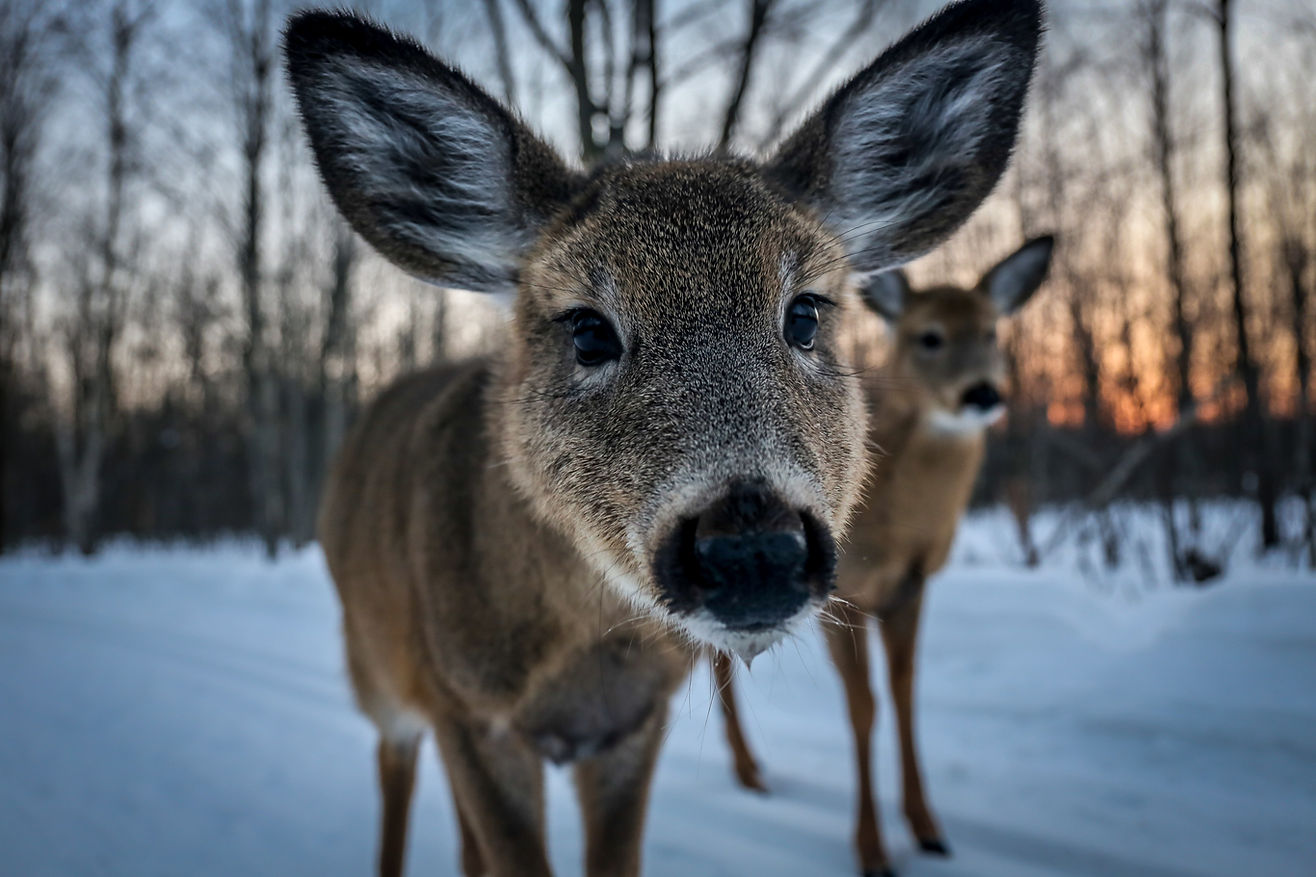
Brayden Dunwoody Shared his Deer Hunting Rules:
When you are in the woods you need to be quiet because you need to not be loud and you need to be in a deer blind or tree stand or you can just lay on the ground.
You want to aim behind the shoulder and shoot.
And you could shoot them in the head if it's a female but if it's a male if you want the skull shoot it behind the shoulder.
Unless you are a good shot do not try to shoot the deer when it is running or walking. That is a good way to not kill the deer and if you want to hunt on state grounds you need a permit.
If it's your first time hunting you need to take a hunting safety class to get your hunting permit. Deer hunting involves scouting for tracks and signs, setting up in a concealed stand or blind downwind of trails.
and using patience to wait for a clear shot at a deer's vital organs.
Key elements include wearing safety gear, understanding wind direction for scent control, and having proper licensing, with peak activity during early morning and late afternoon.
Always hunt with the wind in your face (blowing from the deer to you) to avoid being smelled.
Before you hunt, have some idea of how the wind will affect the way you enter your hunting area and where you will be hunting.
If the wind is from the East and your access is from the East you have a problem.
Also, as you hunt, do your best to hunt a crosswind or keep the wind in your face. If they smell you you’ll never see them.


Marlee McLaughlin shared a step-by-step guide on how to draw a mushroom, featuring some of her original artwork.
First step: You can sketch out a mushroom shape either using straight lines or circles. Personally, what helps me do this, is pulling up a reference. Morels are quite popular so there are plenty online, and especially in this area— you could probably find one on the ground and have a live reference. For the sketching line you should be very light with your pencil as you are just starting out. These sketching lines will not be your final lines, though they might be very close to it.
Second step: by this step, you should be defining your official lines of the drawing. A morel’s cap tends to lean off onto one side, holding a sort of bumpy shape. Using your sketch lines, you can press harder with your pencil as you begin to finalize the actual lines. This step will take quite a while. Nature can be random at times and could form an irregular shape, what I am trying to say is if you can make this mushroom the way that makes it feel right. To help picture it in your mind, you could base the lines off of a background you would find this mushroom. Maybe sketch out a tree in the back, for mine I simply added grass to the bottom to give the morel a base.
Third step: Begin to add the signature holes the mushroom has, most of them will look like little stretched out hearts. Each one will fit around each other like a pattern of stepping stones. Some may be little holes/dots whilst others will be larger and look more like a blob than a little heart like I mentioned earlier. This step is VERY important, it makes the morel look like a morel. Without them, it might just be a regular ole mushroom, like a grey oyster mushroom.
Fourth step: Add details— such as shading. Shading the mushroom will really give that look of dimension that helps it come to life. What helps me shade is putting down a light starting point with my pencil. Slowly working up the darker gradients, Make sure to really add shading around the main base of the morel. Shading it at the point gives the view that the cap is larger than the base. Shading is quite hard to explain in writing, it is more of a thing you feel as you draw.
Now, you should have a drawing of a morel mushroom done.
Obviously, a morel mushroom seems kind of specific— so why exactly did I draw a morel? When one thinks of mushroom hunting, you think of hunting morels. They are an edible delight most people around here tend to either eat or sell. It is a familiar sight for many, and I think it represents my hometown quite well. It is also a very interesting mushroom, there is not one mushroom that looks familiar to it. You look at my drawing and go, “Oh! It’s a drawing of a morel.”